Showing posts with label constant. Show all posts

Monday, 4 April 2016

Air Conditioner Working Principle.


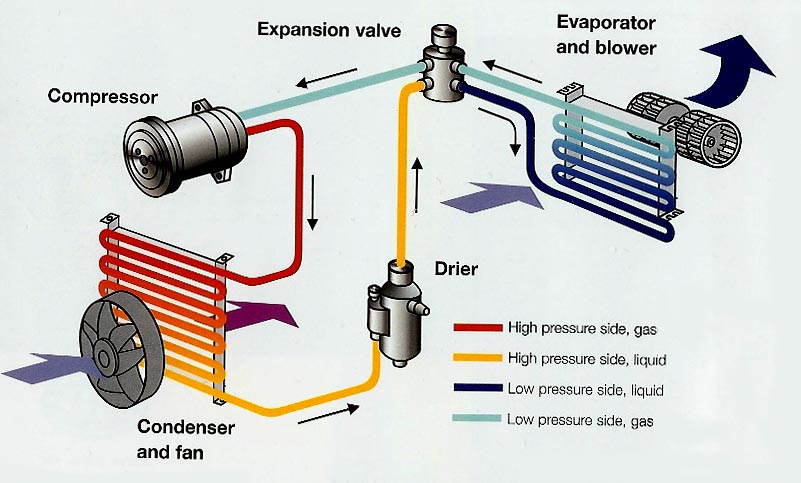
Window air conditioners are very simple appliances. They operate on the exact same principles as a refrigerator, freezer, or dehumidifier.

Please look for information on how window air conditioners work in these areas:

Cooling:

All residential window air conditioners have a cooling system made up of four primary components, a compressor, an evaporator, a metering device, and a condenser. Air conditioner cooling systems are better understood if you think of them as devices that remove warmth from the air rather than cooling the air.

Blower fan:

When the unit is running, the circulating fan and compressor are running simultaneously. The fan motor has two fan blades attached to it on either end. The fan blade on the inside part of the unit continually draws room air over the evaporator coils, which are cold. The fan blade on the outside part of the unit continually draws fresh outside air over the condenser coils, which are warm. Because the evaporator coils are cold, they cause moisture in the room to collect on them, much like a cup of ice water on a warm, humid day. When the amount of moisture increases, it begins to drip down off of the coils into the bottom pan of the air conditioner.

Thermostat control:

The thermostat on a window air conditioner works by sensing the air temperature entering the air conditioner. As the air entering the unit reaches the set temperature it will cause the compressor to turn off. The blower may continue to run depending on the selection chosen on the control panel. Digital thermostats work on a similar principle but display a more precise temperature.
www.facebook.com

Selector switches:

The air conditioner selector switches allow the user to choose the fan speed. The compressor always runs at the same speed regardless of the settings. If low cool is chosen, for example, the fan runs at a slower speed but the compressor still offers the same cooling capacity. There are other switches to control louver operation and other features on some units.

Air conditioning Systems

Selection criteria for air conditioning systems: 

Selection of a suitable air conditioning system depends on: 
1. Capacity, performance and spatial requirements 
2. Initial and running costs 
3. Required system reliability and flexibility 
4. Maintainability 
5. Architectural constraints Q plant Thermal Distribution System 

The relative importance of the above factors varies from building owner to owner and may vary from project to project. 
The typical space requirement for large air conditioning systems may vary from about 4 percent to about 9 percent of the gross building area, depending upon the type of the system. 
Normally based on the selection criteria, the choice is narrowed down to 2 to 3 systems, out of which one will be selected finally.
http://mepsite.blogspot.in/


Classification of air conditioning systems: 

Based on the fluid media used in the thermal distribution system, air conditioning systems can be classified as: 
1. All air systems 
2. All water systems 
3. Air- water systems 
4. Unitary refrigerant based systems.

All air systems: 

As the name implies, in an all air system air is used as the media that transports energy from the conditioned space to the A/C plant. In these systems air is processed in the A/C plant and this processed air is then conveyed to the conditioned space through insulated ducts using blowers and fans. This air extracts (or supplies in case of winter) the required amount of sensible and latent heat from the conditioned space. The return air from the conditioned space is conveyed back to the plant, where it again undergoes the required processing thus completing the cycle. No additional processing of air is required in the conditioned space. All air systems can be further classified into: 
1. Single duct systems, or 
2. Dual duct systems 
The single duct systems can provide either cooling or heating using the same duct, but not both heating and cooling simultaneously. These systems can be further classified into: 
1. Constant volume, single zone systems 
2. Constant volume, multiple zone systems 
3. Variable volume systems 
4 The dual duct systems can provide both cooling and heating simultaneously.
https://www.facebook.com/mepsite/

These systems can be further classified into: 

1. Dual duct, constant volume systems 
2. Dual duct variable volume systems 

About

HVAC is the technology of indoor and vehicular environmental comfort. Its goal is to provide thermal comfort and acceptable indoor air quality. HVAC system design is a subdiscipline of mechanical engineering, based on the principles of thermodynamics, fluid mechanics, and heat transfer. Refrigeration is sometimes added to the field's abbreviation as HVAC&R or HVACR, (heating,ventilating and air-conditioning & Refrigeration) or ventilating is dropped as in HACR (such as the designation of HACR-rated circuit breakers). HVAC is important in the design of medium to large industrial and office buildings such as skyscrapers, onboard vessels, and in marine environments such as aquariums, where safe and healthy building conditions are regulated with respect to temperature and humidity, using fresh air from outdoors. Ventilating or ventilation (the V in HVAC) is the process of "exchanging" or replacing air in any space to provide high indoor air quality which involves temperature control, oxygen replenishment, and removal of moisture, odors, smoke, heat, dust, airborne bacteria, and carbon dioxide. Ventilation removes unpleasant smells and excessive moisture, introduces outside air, keeps interior building air circulating, and prevents stagnation of the interior air. Ventilation includes both the exchange of air to the outside as well as circulation of air within the building. It is one of the most important factors for maintaining acceptable indoor air quality in buildings. Methods for ventilating a building may be divided into mechanical/forced and natural types.